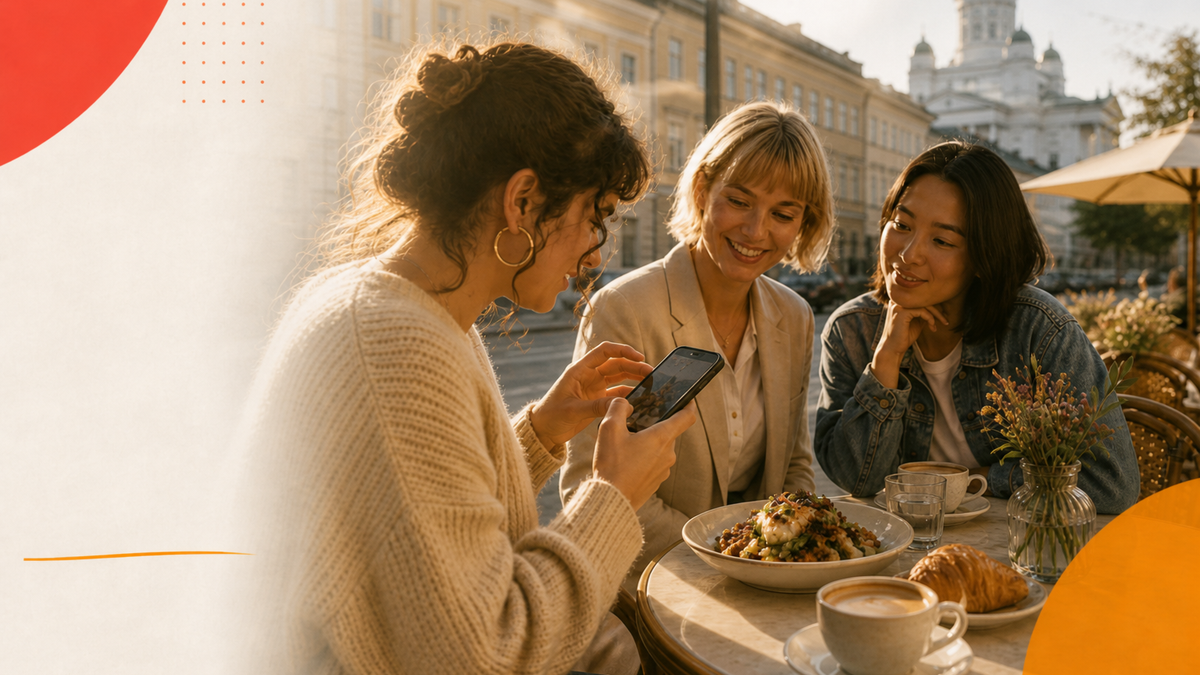
Nielsen asked more than 40,000 people in 56 countries which advertising formats they trust. Recommendations from people they know came first, at about 88%. Ads delivered by influencers came near the bottom, at about 23%.[1] Both describe roughly the same physical thing: a human on a screen saying something good about a product. The gap between them is the subject of this article.
Trust tracks one variable more than raw follower count: whether the audience reads the speaker as a peer with little to gain, or as a commercial channel with an obvious stake. A brand speaking in the first person sits at the commercial end of that scale. A nano-creator with a few hundred neighbours following them sits close to the other end.
1. Why brand self-promotion loses trust
Brand self-promotion loses trust because listeners discount claims made by the party with the most to gain. Irene Scopelliti, George Loewenstein and Joachim Vosgerau ran three experiments published in Psychological Science in 2015. Self-promoters consistently overestimated how much pride their announcements produced in listeners, and underestimated annoyance. Heavy self-promotion made the promoter less likeable — and more of a braggart.[2]
Projection is the mechanism: the promoter feels proud, assumes the listener feels proud too, and turns the volume up. The listener is running a different emotional program.
A brand advertisement in the first person is structurally the same act. “Our coffee is the best in Helsinki” is a claim made by the party with the most to gain from it being believed. Audiences discount it for the same reason they discount a colleague’s third promotion announcement of the week.
2. Persuasion knowledge: the switch that gets flipped
Persuasion knowledge is a consumer’s working theory of how marketers try to persuade them — and it activates the moment a message is recognised as a persuasion attempt. Marian Friestad and Peter Wright’s Persuasion Knowledge Model (Journal of Consumer Research, 1994) is the backbone of almost every later study in this field. Recognition triggers a detachment effect; the message does not need to be false.[3]
- Recognition is the trigger, not dishonesty. The message only needs to be identified as advertising.
- Brand-owned advertising has zero ambiguity. The logo is the disclosure. Persuasion knowledge fires before the first line of copy is read.
- A creator post occupies the ambiguous middle. Persuasion knowledge still activates in 2026 — audiences are not naive — but against a source who also posts about their broken bike and replies to comments next week. The discount is smaller.
Survey data has a strange shape for the same reason: the same people who trust branded websites at roughly 70% rate banner and search ads far lower. They do not distrust the brand itself. They distrust the format that announces a persuasion attempt they did not ask for.
3. What trust surveys actually measure about influencer advertising
Trust surveys measure perceived motive more than medium quality: person-to-person recommendation ranks near the top, while the same act labelled as influencer advertising ranks near the bottom.
Recommendations from people I know vs ads from influencers
Nielsen’s Trust in Advertising study (fieldwork August–September 2021) spanned Gen Z through the Silent Generation across 56 countries. Read the top and bottom rows together:[1]
| Channel | Completely or somewhat trust |
|---|---|
| Recommendations from people I know | 88–89% |
| Brand sponsorship at sporting events | 81% |
| Ads from influencers | 23% |
Person-to-person recommendation is the most trusted format measured. Once the person is labelled an influencer and the recommendation is understood to be bought, trust drops toward the bottom. Nothing about the medium changed. The perceived motive did.
Earlier Nielsen waves show the ranking is stable: recommendations from people you know stayed near the top across 2013–2015, while earned formats such as consumer opinions posted online consistently beat paid display.[4]
Edelman 2026: trust is moving toward the neighbour
Edelman’s 2026 Trust Barometer surveyed 33,938 adults across 28 countries and found trust relocating toward whoever is physically and socially closest — a pattern Edelman calls insularity. Among respondents whose confidence shifted after major events, neighbours, family and friends gained +11 points while national government leaders lost −16 points.[5]
| Source of information | Net trust change |
|---|---|
| National government leaders | −16 points |
| Major news organisations | −11 points |
| My neighbours, family and friends | +11 points |
| My coworkers | +11 points |
For a local business this is commercially decisive. National advertising is losing altitude while neighbours gain it. A creator who lives four streets away is not a cheaper version of a national campaign — they are a different asset class, and the one that is appreciating.
Authenticity rankings (with a caveat)
Stackla/Nosto consumer waves often cited in industry decks find user-generated content far more influential and authentic than brand-created or influencer-created content on self-report scales.[6] Treat the direction as useful and the exact multiples as marketing: these are vendor-commissioned surveys. The peer-reviewed work below exists to do what those surveys cannot.
4. Peer-reviewed evidence: why micro-influencers and small creators earn trust
Peer-reviewed experiments show influencers often outperform celebrities on identification, similarity and trust — and that micro creators can outperform macros on knowledge and purchase intention even when sponsorship is disclosed.
Influencers beat celebrities — and trust is the reason
Schouten, Janssen and Verspaget (2020) compared celebrity versus influencer endorsers across beauty, fitness, food and fashion. Participants identified more with influencers, felt more similar to them, and trusted them more. Similarity, wishful identification and trust mediated advertising outcomes. Product–endorser fit explained none of the effect.[7]
That last detail matters. The industry spends most selection effort on category fit. The experiment says perceived similarity and trust drove the result.
Follower count buys likeability, not authority
De Veirman, Cauberghe and Hudders (2017) found high Instagram follower counts increase likeability via perceived popularity — but popularity does not reliably translate into opinion leadership. For divergent products, a large following could even hurt brand attitude.[8] Follower count buys affection. It does not reliably buy credible recommendation.
Micro influencers beat macros on knowledge and intent — even with disclosure
Kay, Mulcahy and Parkinson (2020) found participants exposed to micro-influencers reported higher product knowledge. Micro-influencers who disclosed sponsorship produced higher purchase intentions than macros who did not disclose, and higher than hidden sponsorship.[9]
Persuasion-knowledge theory predicts disclosure should hurt. In the micro condition it helped. The plausible reading: when the source reads as a peer, admitting the commercial relationship reads as honesty. When the source is already large and polished, disclosure confirms what the audience suspected.
Layperson presentation outperforms micro-celebrity framing
A 2024 online experiment held the influencer constant and varied only self-presentation — layperson, opinion leader, or micro-celebrity — in a sponsored post. The layperson presentation was more persuasive; mediators were trust and social attractiveness. Imperfect, personal details functioned as a truth-telling signal.[10]
Trust outweighs expertise and attractiveness
A 2025 Journal of Consumer Marketing study of micro health-and-fitness influencers found trust carried the largest total effect on attitude, ahead of attractiveness and expertise.[11] Related work finds higher parasocial interaction with micro-influencers — the sense of closeness Horton and Wohl described in 1956 — which raises message acceptance.[12] Small accounts generate that closeness more efficiently because reciprocity is closer to real: a nano-creator with 800 followers often does reply.
What the meta-analyses say
Two Journal of the Academy of Marketing Science meta-analyses (2024–2025) synthesise hundreds of effect sizes. Social media influencers tend to outperform brand posts, virtual influencers and celebrities, working through credibility and attractiveness. Small and medium influencers are stronger on engagement; larger influencers can have more impact on purchase intention.[13][14] That last split is the honest limit of the small-creator thesis — covered in the counter-evidence section.
5. Word-of-mouth economics and nano creator engagement rates
Word of mouth carries more long-run signup elasticity than traditional marketing events or media appearances, and 2026 engagement benchmarks still concentrate attention in smaller accounts.
Trusov, Bucklin and Pauwels (2009) measured word of mouth against traditional marketing on a social network. Long-run elasticity of signups with respect to WOM was 0.53 — roughly 20× marketing events and 30× media appearances — with longer carryover than paid actions.[15] An ad stops when you stop paying; a recommendation keeps propagating.
2026 engagement benchmarks show the same shape — attention concentrates in smaller accounts — though panels use different formulas, so absolute percentages are not cross-comparable. The consistent pattern is a decline as account size grows:
| Tier | Engagement rate (indicative) |
|---|---|
| Platform-wide average | ~0.48% (Q1 2026) |
| Nano (1K–10K) | ~3.5–6%+ depending on format/source |
| Micro (10K–100K) | ~1.5–3.5% static; higher on Reels |
| Macro (1M+) | ~0.8–2% |
Marketer behaviour is moving with the economics: Kantar’s Media Reactions 2025 found a net 61% of marketers planning to increase influencer spend in 2026.[16]
6. The revenue evidence: smaller creators can be more efficient
Paid Instagram revenue data shows nano creators can generate higher revenue per follower and higher return on influencer spend than macros, even when absolute revenue favours larger accounts. Beichert, Bayerl, Goldenberg and Lanz (2024) analysed the full paid-influencer funnel — followers, actual reach, engagement, purchases, revenue and endorsement costs — using 2,808 influencer-specific discount codes from 1,698 Instagram creators, attributing 1,881,533 sold products and more than €17 million in revenue, then confirming the direction with three field studies.[17]
| Metric | Nano | Micro | Macro |
|---|---|---|---|
| Revenue per follower | €0.265 | €0.080 | €0.049 |
| Revenue per reached follower | €0.881 | €0.305 | €0.237 |
| Return on influencer spend (ROIS) | 17.85 | 5.98 | 4.67 |
Macro-influencers in the dataset had roughly 32× as many followers as nano-influencers but generated only about four times as much revenue. Absolute revenue was higher for larger creators, but costs rose faster: about six times the revenue at roughly eighteen times the cost. Average ROIS was more than three times higher for nano-influencers.[17]
Across three field studies, revenue per follower was between 17 and 114 times higher for low-followership than high-followership targeting. High-followership creators were also paid at least three times more.[17]
What this proves — and what it does not
- Strong evidence: in this paid Instagram DTC context, smaller creators produced materially better revenue efficiency and return on spend.
- Strong evidence: the direction held after accounting for actual reach and in controlled field studies.
- Important limit: the main data came from a European DTC fashion company using discount codes. A restaurant visit is a different kind of purchase decision.
- Do not claim: that nano-influencers produce “3.8× better ROI for every business,” or that Helsinki barter campaigns will replicate the exact multipliers.
Useful inference: smaller, well-matched creators can be economically attractive when cost and local fit are considered together. How to score that fit in practice — including commercially relevant reach — is in how to choose a local creator; product matching lives on Promobeez for businesses.
7. Why local businesses need neighbour-level creator trust
Local businesses need neighbour-level creator trust because discovery is fragmenting toward third-party evidence while trust itself is relocating toward people nearby. BrightLocal’s Local Consumer Review Survey 2026 found AI tools for discovering local businesses jumped from 6% to 45% in one year, Google’s share of local discovery fell from 83% to 71%, and 97% of consumers still read reviews when evaluating a local business.[18] Creator posts and reviews feed that third-party layer; brand ads do not — a pattern that pairs with Edelman’s neighbour trust gain and is developed further in how to choose a creator for your business.
8. Counter-evidence: when the small-creator trust premium breaks
Small-creator trust breaks when the creator starts to read as a professional endorsement channel, when audiences already distrust influencers, or when the campaign objective rewards mass reach and status more than peer similarity.
- The influencer label is itself a liability. Nielsen’s 23% figure is damaging for anyone selling creator marketing.[1] The small-creator thesis holds while the creator does not read as a professional endorsement channel. Scale a nano into weekly sponsored posts and you convert a trusted source into an untrusted one.
- Skepticism is the baseline. A 2025 BBB National Programs study reported that most consumers distrust influencers they do not see as honest and transparent; boilerplate “Ad” tags tucked late can now read as a red flag.[19]
- De-influencing is durable. Anti-haul and “what not to buy” content reflects fatigue with generic endorsement and pushes product talk into smaller peer communities brands cannot easily buy.
- Bigger creators can win on purchase intention. The 2025 JAMS meta-analysis finds small/medium creators stronger on engagement, larger creators stronger on purchase intention.[13] Small creators win on trust and engagement per impression — not on every KPI.
- Vendor statistics are soft. Roundups quoting micro-influencer trust between 49% and 81% with no methodology — or inventing Nielsen figures that contradict Nielsen’s own 23% — should not enter a board deck.
Follower count and engagement are not linear. A multimethod Journal of Marketing study of 802 Instagram campaigns found an inverted U-shaped relationship between follower count and engagement with sponsored content — a “Goldilocks” effect. Engagement rises with reach, then declines as psychological distance grows.[20]
Four experiments by Ceylan and Hayran (2025) found a matching effect: macro-influencers were more effective for more popular brands, while micro-influencers were more effective for less popular brands.[21] High follower counts can also signal popularity while reducing perceived uniqueness for divergent products — the finding already summarised in section 4.[8]
When bigger genuinely wins
Larger creators may be the better choice when:
- mass awareness is the primary goal
- the brand is already famous or aspirational
- the campaign needs status signalling
- the creator has recognised category expertise
- the organisation cannot manage a portfolio of smaller partners
- the audience is not geographically constrained (national e-commerce, digital products)
FAQ
Do small creators always outperform?
No. Small creators often win on trust, engagement efficiency and revenue per follower in the paid Instagram contexts studied to date. Larger creators can still win on mass awareness, status signalling and, in some meta-analyses, purchase intention at volume.
Can I use the Journal of Marketing revenue figures as my own benchmark?
Use them as directional evidence that smaller creators can be more efficient — not as a universal multiplier. The main Beichert et al. (2024) dataset was a European DTC fashion company using discount codes, not restaurant visits or local barter campaigns.
Does disclosure destroy trust?
Not necessarily. Kay, Mulcahy and Parkinson (2020) found micro-influencers who disclosed sponsorship produced higher purchase intentions than macros who did not. Early, plain disclosure can read as honesty when the source already feels like a peer.
References
- Nielsen. (2021). Trust in Advertising Study. Fieldwork August–September 2021; 40,000+ respondents, 56 countries.
- Scopelliti, I., Loewenstein, G., & Vosgerau, J. (2015). You Call It “Self-Exuberance”; I Call It “Bragging”. Psychological Science, 26(6), 903–914. https://doi.org/10.1177/0956797615573516
- Friestad, M., & Wright, P. (1994). The Persuasion Knowledge Model. Journal of Consumer Research, 21(1), 1–31. https://doi.org/10.1086/209380
- Nielsen. Global Trust in Advertising Survey, Q1 2015 (and related 2012–2013 waves).
- Edelman. (2026). 2026 Edelman Trust Barometer. Published 18 January 2026. edelman.com/trust/2026/trust-barometer
- Stackla / Nosto. Consumer Content Report waves (US/UK/Australia). Vendor-commissioned; directional only.
- Schouten, A. P., Janssen, L., & Verspaget, M. (2020). Celebrity vs. Influencer Endorsements in Advertising. International Journal of Advertising, 39(2), 258–281. https://doi.org/10.1080/02650487.2019.1634898
- De Veirman, M., Cauberghe, V., & Hudders, L. (2017). Marketing through Instagram Influencers. International Journal of Advertising, 36(5), 798–828. https://doi.org/10.1080/02650487.2017.1348035
- Kay, S., Mulcahy, R., & Parkinson, J. (2020). When Less Is More. Journal of Marketing Management, 36(3–4), 248–278. https://doi.org/10.1080/0267257X.2019.1704345
- Influencer self-presentation strategies experiment. (2024). Marketing Intelligence & Planning, 42(7). Online experiment, N = 229.
- Typology of trust in micro health-and-fitness influencers. (2025). Journal of Consumer Marketing, 42(2).
- Horton, D., & Wohl, R. R. (1956). Mass Communication and Para-Social Interaction. Psychiatry, 19(3), 215–229.
- A Meta-Analysis of the Effectiveness of Social Media Influencers. (2025). Journal of the Academy of Marketing Science. https://doi.org/10.1007/s11747-025-01107-3
- Influencer Marketing Effectiveness: A Meta-Analytic Review. (2024). Journal of the Academy of Marketing Science. https://doi.org/10.1007/s11747-024-01052-7
- Trusov, M., Bucklin, R. E., & Pauwels, K. (2009). Effects of Word-of-Mouth versus Traditional Marketing. Journal of Marketing, 73(5), 90–102. https://doi.org/10.1509/jmkg.73.5.90
- Kantar. (2025). Media Reactions 2025. Published 23 September 2025.
- Beichert, M., Bayerl, A., Goldenberg, J., & Lanz, A. (2024). Revenue Generation Through Influencer Marketing. Journal of Marketing, 88(4), 40–63. https://doi.org/10.1177/00222429231217471
- BrightLocal. (2026). Local Consumer Review Survey 2026. Published 11 February 2026. brightlocal.com/research/local-consumer-review-survey/
- BBB National Programs influencer trust findings, reported via eMarketer (2025); Clutch consumer survey on influencer trust (June 2025).
- Wies, S., Bleier, A., & Edeling, A. (2023). Finding Goldilocks Influencers: How Follower Count Drives Social Media Engagement. Journal of Marketing, 87(3), 383–405. https://doi.org/10.1177/00222429221125131
- Ceylan, M., & Hayran, C. (2025). Social media influencer marketing: the role of influencer type, brand popularity, and consumers’ need for uniqueness. International Journal of Advertising, 44(7), 1366–1393. https://doi.org/10.1080/02650487.2024.2387073
Match with creators people already trust
Promobeez connects neighbourhood businesses with nano and micro creators whose audiences live nearby — barter deals, clear disclosure, no commissions.
For businesses →