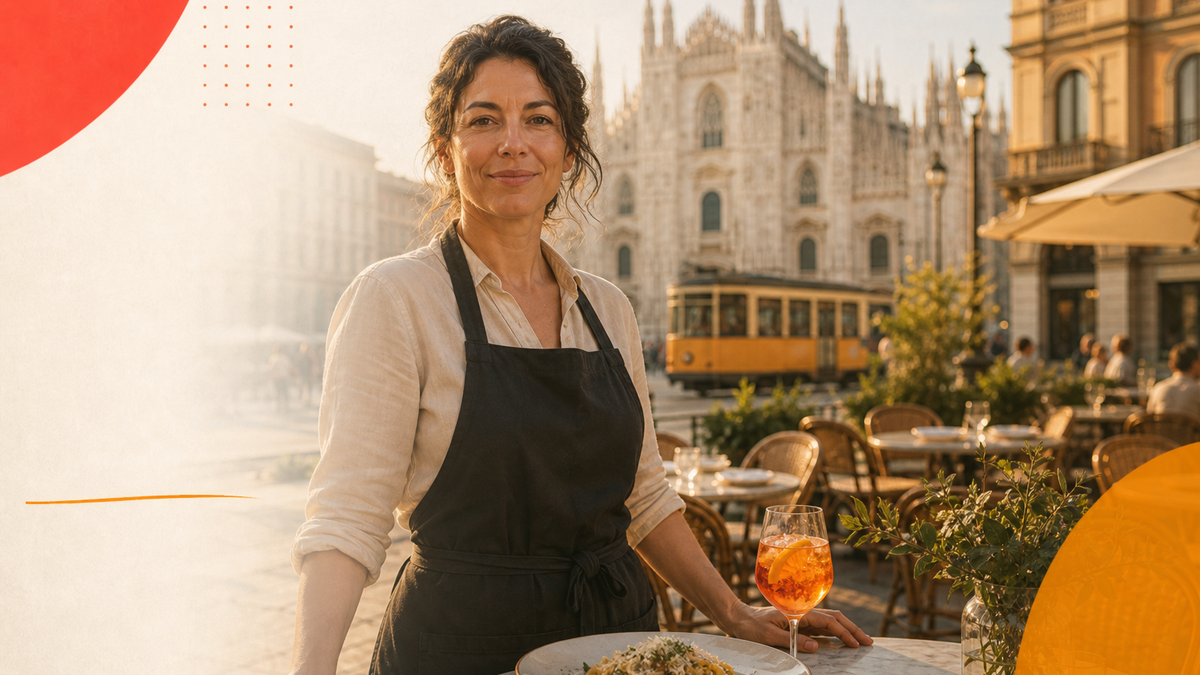
The problem in Milan is not weak demand. It is the number of alternatives. Fipe's Rapporto Ristorazione 2026, presented in Rome on 9 April 2026, counts more than 324,000 active foodservice businesses in Italy in 2025 and demand approaching €100 billion, up 3.7%.[1] In Milan that density is packed into a few square kilometres: a hungry person has twenty options within a ten-minute walk and no particular reason to pick you.
And they decide on a screen. A TheFork study run with YouGov among more than 1,000 Italians between December 2025 and March 2026 found that for 43% of Italians aged 25 and over — and 56% of those who book online — reviews are the most influential factor when choosing a restaurant, followed at 33% by the chance to judge photos, menu and atmosphere for themselves. Before booking, users spend an average of over 13 minutes on review pages, and 43% read between four and seven reviews.[2]
Thirteen minutes of reading before a €40 dinner. That is where the cover is won or lost, not in Friday's post.
1. How Milan actually decides
Four surfaces carry nearly the whole decision.
Google Maps. The "ristoranti vicino a me" and "brunch Isola" moment, still the single biggest channel, especially for anyone who is not from the neighbourhood.
Review and booking platforms. TheFork published 3 million new reviews worldwide in 2025, 1.2 million of them in Italy, and almost one in two users who leave a rating also writes a comment.[2]
Instagram and TikTok. Under-35s search inside the app. A reel from someone they already follow works as discovery and as proof at the same time.
AI assistants, which in Italy already have a local front door. TheFork launched "Chiedi a TheFork", an AI-based conversational search, in September 2025; within roughly six months usage peaked in Italy specifically, 76% of users move from the results to a restaurant page, and 80% of feedback on the automatic review summaries is positive.[2] Separately, DoorDash's 2026 report, surveying more than 3,000 US consumers, found 22% had already used a tool like ChatGPT or Gemini to choose a restaurant.[3] That figure is American — read it as direction, not as a Milan number.
The oldest channel still holds too. In the same TheFork–YouGov survey, eight in ten Italians over 25 said the opinion of friends and family is decisive.[2] A local creator recommending a place to their followers is operating on that register, not on the advertising one.
2. Google Business Profile: the parts that move
Treat the Google profile as the product page and your website as support material. Most local ranking work happens here, and nearly all of it is free.
Google weighs three things: relevance, distance and prominence. Distance you cannot change. Relevance is category and content. Prominence is reviews, mentions and consistency of your data across the web.
Categories. The primary category outweighs almost every other field. "Restaurant" is too generic to win anything in Milan. Pick the exact one — Neapolitan pizzeria, trattoria, Japanese restaurant, cocktail bar, brunch restaurant — and add secondary categories for what you genuinely sell. A bar serving a full lunch should say so in a category, not only in a caption.
Hours, exceptions included. Ferragosto, the August closure, the Christmas period, your weekly closing day: enter them in advance, not after the first angry review. Aggregated 2026 local-SEO analysis reports that profiles with consistently accurate hours are favoured in AI-driven local features, and wrong hours are among the most frequent causes of negative reviews.[4]
The menu as structured text. Put the menu on your own site as real text, not a PDF and not an image. Add Restaurant, Menu and FAQPage schema. A PDF menu is invisible to the systems that now answer "where can I eat gluten-free near Porta Romana".
Photos, weekly. Dining room, exterior at night, the three dishes you want ordered, the terrace, the team. Photo views and direction requests are engagement signals.
Attributes. Accessible, outdoor seating, vegan options, dog friendly, booking recommended. This is how filtered searches find you and how an assistant qualifies you against a constraint.
Posts. One a week is enough: the lunch menu, this week's dish, the terrace opening. Short and dated.
3. Getting named by an AI assistant
An assistant does not list ten results. It names three to five and stops. Uberall's May 2026 benchmark across ChatGPT, Gemini, Perplexity, Copilot and Google AI Overviews found that 83% of restaurant locations never appear in AI-generated recommendations even though 86% are present on Google, and that the platforms apply a rating floor: ChatGPT mainly recommends businesses averaging 4.3 stars or higher, Perplexity around 4.1, Gemini around 3.9.[5]
A restaurant at 4.0 can therefore rank on Maps and be structurally excluded from the answer. It is the most operational number in this article.
| Signal | What to do about it |
|---|---|
| Rating level | Get above 4.3 and stay there. Below 4.1, fix the service, not the marketing. |
| Review recency | A steady flow of recent reviews outweighs a large old archive. |
| Listing completeness | Hours, categories, attributes, menu, photos, phone, website — filled everywhere, identical everywhere. |
| Structured data | Restaurant + Menu + FAQPage on your own site, kept current. |
| Third-party sources | Directories and review platforms supply over 41% of the sources AI tools cite for restaurant recommendations, per Yext data reported in 2026.[6] |
The page almost nobody has: a plain FAQ on your own site answering what people actually ask an assistant. Do you take walk-ins on Friday? Is there gluten-free pasta? Is there a table for eight? Can we bring a dog? One short paragraph each, in Italian and English. That text is retrievable in a way a beautiful homepage video is not.
4. Reviews: consistency over volume
Reviews are the highest-return asset a Milan restaurant owns, and the one handled most passively.
- Ask at the moment the guest is happy. Not on the receipt. When a table says the meal was good, the person in the room says: "thank you — would you write that in a Google review?" Used consistently by the whole floor, that sentence is worth more than any ad budget under €500.
- Never buy or reward them. Offering a coffee in exchange for a review is an unfair practice under the Italian Consumer Code and breaks platform rules.
- Reply to all of them within 48 hours. Positive ones included. Response rate is treated as a ranking and trust signal.[4]
- Answer the one-star in public, resolve it in private. Two sentences, no defensiveness, an invitation to email. You are writing for the next 200 readers.
- Check the threshold weekly. Under 4.3 becomes a floor meeting, not a marketing meeting.
5. The Milan calendar: when the money is actually there
Milan demand is not flat, and no generic guide will tell you this. Plan against the year the city really has.
| Period | What happens | What to run |
|---|---|---|
| January–February | Slow months after the holidays; womenswear fashion week in February | Lunch menu, regulars programme, fix profile and photos now |
| March | The city restarts, first terraces | Announce the terrace, run creator collaborations |
| April | Salone del Mobile and Fuorisalone: the densest week of the year | Short fast menu, extended hours, English pages, prepaid bookings |
| May–June | Terrace high season, long aperitivo | Terrace content, themed evenings, corporate groups before the holidays |
| July | Tourists in the centre, Milanese leaving | English menu, Maps photos, walk-in capacity |
| August | The city empties around Ferragosto | Either close, or say clearly that you are open — the people who stay are looking for exactly that |
| September | Return, fashion week, corporate budgets reopen | Back-to-town campaigns, business lunches, new menu |
| October–November | The most solid trading period | Company dinners, groups, December bookings already open |
| December | Peak, then a drop after the 24th | Group menus, gift cards, New Year |
Two underused levers. First, lunch: the weekday pausa pranzo is the most predictable revenue of the week and the least communicated — a daily menu published as text on your own site catches exactly the searches people run at 12:10. Second, aperitivo as a product, not as a discount: a format with a name, a time and a stated price can be told in a reel. "Aperitivo from 6pm" cannot.
If February 2026 brought you international traffic, those English pages keep earning: during Salone and the fashion weeks, a large share of people searching for dinner do not read Italian.
6. Districts, and why creator geography is city-wide
Navigli, Isola, NoLo, Porta Romana, Brera, Porta Venezia, Città Studi and Lambrate behave like different markets on price, timing and the kind of guest who walks in. Your categories, photos and language should match the one you are in.
Creator selection runs the other way. In a city with this much metro coverage, targeting the creator's home district makes no sense: what matters is whether their audience is in Milan, not which zone they sleep in. A creator living in Sesto with 70% Milanese followers is a better partner than one from Isola followed across the whole country.
Ask for the audience geography screenshot from their professional account. It takes them fifteen seconds and it is the only verifiable number in the entire conversation. The full selection method is in how to choose a local creator — the ten-factor checklist there does that job, so it is not repeated here.
7. Working with local creators without a cash budget
For a single venue, nano and micro creators with audiences concentrated in Milan usually beat large accounts, because a recommendation is worth something only if the reader can act on it this week. A 2026 study of 474 social-media users who follow food influencers found that trust helped explain how identification with an influencer turned into intention to visit a restaurant.[7] A 2024 Journal of Marketing study of 1,698 Instagram creators also found lower-followership creators generated higher revenue per follower in a direct-to-consumer setting — a directional finding, not a multiplier for Milanese barter.[8]
How to set up an exchange that works:
- Size the offer to something the creator would have bought anyway. A pasta and a glass for two. A tasting in exchange for a review. Something with a legible price: €25 reads as €25, "a complimentary experience" reads as homework.
- Ask for one thing, not five. One reel, or one carousel plus one story with the location tag. Requirement creep is what kills these collaborations.
- Book them into a quiet service. Tuesday at 19:30, not Saturday at 21:00. You want a calm kitchen, a photogenic room, and a table that would have stayed empty.
- Give the shot list, not the script. Two dishes you want ordered, the detail you want in frame, the tag and the location. The words stay theirs — that is the whole value.
- Agree reuse rights in writing before the visit. Can you repost the reel on your profile, for how long, with or without their handle. Almost everyone says yes when asked first; almost nobody says yes afterwards.
- Judge a series, not a post. Four small collaborations over two months beat one large one and leave you content for a quarter.
The exceptions — cases where a larger creator is the better call — are in why audiences trust small creators more than brand ads.
8. Disclosure: what AGCOM and the Digital Chart require
This is where a restaurant can get it seriously wrong, and it is avoided with one line in the brief.
The framework consolidated with AGCOM resolution 197/25/CONS, published on 5 August 2025, which approved guidelines and a code of conduct for influencers. On 16 March 2026 the Authority published operational FAQs translating the rules post by post.[9]
Four points that concern a restaurant directly:
- Transparency obligations apply to everyone. Registration in the register of relevant influencers applies to those above 500,000 followers or one million average monthly views on a single platform; the first deadline was 5 February 2026, and the list is updated on 15 April and 15 October. The substantive rules on recognisability of advertising apply below those thresholds too — that is, to every nano and micro creator you would work with.[9]
- The label must be immediate and textual. "Pubblicità", "Advertising", "ADV", "Sponsorizzato da…" or equivalent wording, visible straight away and without any action from the user. The IAP Digital Chart requires the indication to appear among the first three hashtags.[10]
- A platform label is not enough on its own. Instagram's branded content or paid partnership tag can help, but according to the AGCOM FAQs it does not replace the textual disclosure.[9]
- Hospitality has its own wording. When a restaurant or hotel provides the meal or the stay, the indicated practice is along the lines of "#invitedby / invitato da…" or "offered by…", naming the host.[11]
Operating rule: put the required wording in the written brief every time, and check the post within 24 hours of publication. Formal responsibility sits with the creator, but the Italian competition authority also sanctions brands and agencies for hidden advertising. None of this is legal advice — for a recurring contract template, have an Italian lawyer look at it.
9. Delivery, booking, and owning the guest
Glovo, Deliveroo and Just Eat are discovery channels in Milan as much as delivery channels — people browse them the way they used to browse Google. Be there, keep the photography clean, and treat commission as a customer-acquisition cost rather than an insult to margin.
Then build the channel you own. A direct booking link on the Google profile, a reservation flow that works on your own site, an email or WhatsApp list collected at the till and from group bookings. One well-made email to 800 past guests announcing the autumn menu costs nothing and outperforms nearly all the paid social an independent restaurant can afford.
10. Lists, guides and local press
Editorial mentions do two jobs now: they bring readers, and they feed the sources assistants cite. In Milan the target list is long — city guides, local food titles, neighbourhood newsletters, district Facebook groups (as a participant, not an advertiser), and two or three journalists who genuinely cover Milanese dining.
The approach that works is dull and almost nobody does it: send a short note when the menu changes, not a press release when you need covers.
11. What to measure, weekly
Ten minutes every Monday, one sheet:
- Google profile: views, direction requests, calls, website clicks
- New reviews this week and the running average
- Bookings by source: direct, Google, platform, phone
- Covers on the two weak services you are trying to fill
- Redemptions of the code word given to a creator
- Saves and shares on your own posts — better predictors of visits than likes
Give every collaboration a trackable ask: a code word at the till, a UTM link, or "mention the reel". Without it you are guessing, and guessing is how a €200 barter becomes a €200 opinion.
12. A 90-day plan
Days 1–14 — foundation. Categories, hours with exceptions, attributes, 20 new photos, menu as text on the site with Restaurant and Menu schema, an FAQ page in Italian and English. Claim and align every listing.
Days 15–45 — reviews and lunch. A floor script for asking. Replies to all reviews within 48 hours. Daily menu published as text. Weekly measurement sheet live.
Days 46–75 — creators. A shortlist of ten local creators chosen on audience geography and category fit. Four small barter collaborations in quiet services, each with a written brief, a mandatory disclosure line and a tracking method.
Days 76–90 — compounding. Repost the best creator content on your own channels under the agreed rights. Pitch a story to two local journalists. Open December bookings if the calendar is anywhere near October. Compare the numbers against day one and cut what did not move.
FAQ
How much should a small Milan restaurant spend on marketing?
Before spending anything: the profile, the menu as text, the review routine. Those cost time. After that, most independent venues get further from a rolling series of barter collaborations and a lunch push than from a small social budget, because €300 of advertising in Milan buys very little and one well-matched reel can fill a Tuesday.
Does a meal given to a creator have to be labelled as advertising?
Yes, when it is given for promotional purposes. Clear and immediate wording is required — "Pubblicità", "ADV", "Sponsorizzato da…" — and for hospitality the indicated formula is along the lines of "invitato da…". The platform partnership tag alone is not sufficient. This is not legal advice.
Does the creator I work with need to be in the AGCOM register?
Only above 500,000 followers or one million average monthly views on a platform. Nano and micro creators do not register, but they remain subject to the transparency rules: the disclosure goes in regardless.
How many followers should a Milan food creator have?
Enough to produce reach that can physically come to you. For a single venue, 3,000 genuinely Milanese followers usually beat 40,000 spread across Italy. Ask for the audience geography screenshot.
Does Google still matter in 2026?
It remains the largest channel and is no longer the only one. Alongside it sit booking platforms with AI search, in-app search on Instagram and TikTok, and general assistants. The useful part: they optimise on nearly the same work — a complete listing, structured data, recent reviews.
Is it worth buying reviews or followers?
No, and not for moral reasons. Assistants weight rating consistency and review recency, platforms remove purchased reviews, and in a Milan neighbourhood reputation travels by word of mouth faster than any bought number.
References
- Fipe-Confcommercio. (2026). Rapporto Ristorazione 2026, presented in Rome on 9 April 2026. https://www.fipe.it/wp-content/uploads/2026/04/Ristorazione-2026.pdf
- TheFork / YouGov. (2026). Study on the "paradox of too much choice": platform data for 2025 and a survey of more than 1,000 Italians between December 2025 and March 2026. https://www.comunicaffe.it/scelta-ristoranti-italia-recensioni-ai-thefork/
- DoorDash. (2026). Restaurant Industry Trends Report 2026, reported 20–21 May 2026. https://www.qsrmagazine.com/news/ai-is-reshaping-how-diners-discover-restaurants-doordash-study-finds/
- Aggregated 2026 Google Business Profile analysis, including Search Engine Land reporting on review recency. https://mooretechsolutions.com/google-business-profile-guide-2026/
- Uberall. (2026). Fast Food, Faster Discovery: The 2026 GEO Playbook for Multi-Location QSRs. Published 7 May 2026. https://www.businesswire.com/news/home/20260507962493/en/
- Yext data on AI citation sources for restaurant recommendations, reported 2026. https://bloomintelligence.com/blog/ai-restaurant-discovery/
- Sumba-Nacipucha, N., Cueva-Estrada, J., Cuesta-Valiño, P., & Ganga-Contreras, F. (2026). From Feed to Table: The Role of Food Influencers in Restaurant Choices. Tourism and Hospitality, 7(3), 83. https://doi.org/10.3390/tourhosp7030083
- Beichert, M., Bayerl, A., Goldenberg, J., & Lanz, A. (2024). Revenue Generation Through Influencer Marketing. Journal of Marketing, 88(4), 40–63. https://doi.org/10.1177/00222429231217471
- AGCOM. Influencer — guidelines, code of conduct and FAQs (resolution 197/25/CONS, published 5 August 2025; operational FAQs 16 March 2026). https://www.agcom.it/influencer-linee-guida-codice-di-condotta-e-faq
- Istituto dell'Autodisciplina Pubblicitaria — Digital Chart Regulation, referenced by the AGCOM guidelines; summary of accepted wording. https://www.pmi.it/impresa/normativa/431236/influencer-agcom-regole-trasparenza-pubblicita.html
- AGCOM, operational FAQs for influencers (Annex B), 16 March 2026. https://www.agcom.it/sites/default/files/media/allegato/2026/Allegato_B_operativo_influencer.pdf
Milan: the waiting list is open
Promobeez matches venues with creators whose audience is genuinely local — an exchange with no money and no commission. We are building the creator pool in Milan now. Leave an address and we will write when it opens.
Join the Milan waiting list →